Luc Léger test: audio, stages and live MAS
Run the 20-metre shuttle test with the complete soundtrack, follow every stage live and download the MP3 for free. For the detailed protocol, preparation and official selection standards, read our complete Luc Léger test guide.
Luc Léger Test
Full soundtrack • 20 stages
Real-time metrics
Stage
Speed
Distance
Shuttles
Time
VMA Test Controls
Before starting: measure 20 metres, choose a stable surface, warm up and stop if you feel pain, dizziness or faintness.
Make sure the volume is loud enough to hear the shuttle run test beeps
For fitness coaches
Do you run this test with your clients?
Centralise their programmes, assessments and progress tracking in Fit'Distance instead of spreading them across files and tools.
What is the Luc Léger Test?
The Luc Léger shuttle run test, also called the 20-metre shuttle run test, is a progressive physical fitness test created by Professor Luc Léger in the 1980s. This test makes it possible to assess VMA (Maximal Aerobic Speed) and to estimate VO2Max, a key indicator of maximal oxygen consumption and cardiovascular endurance.
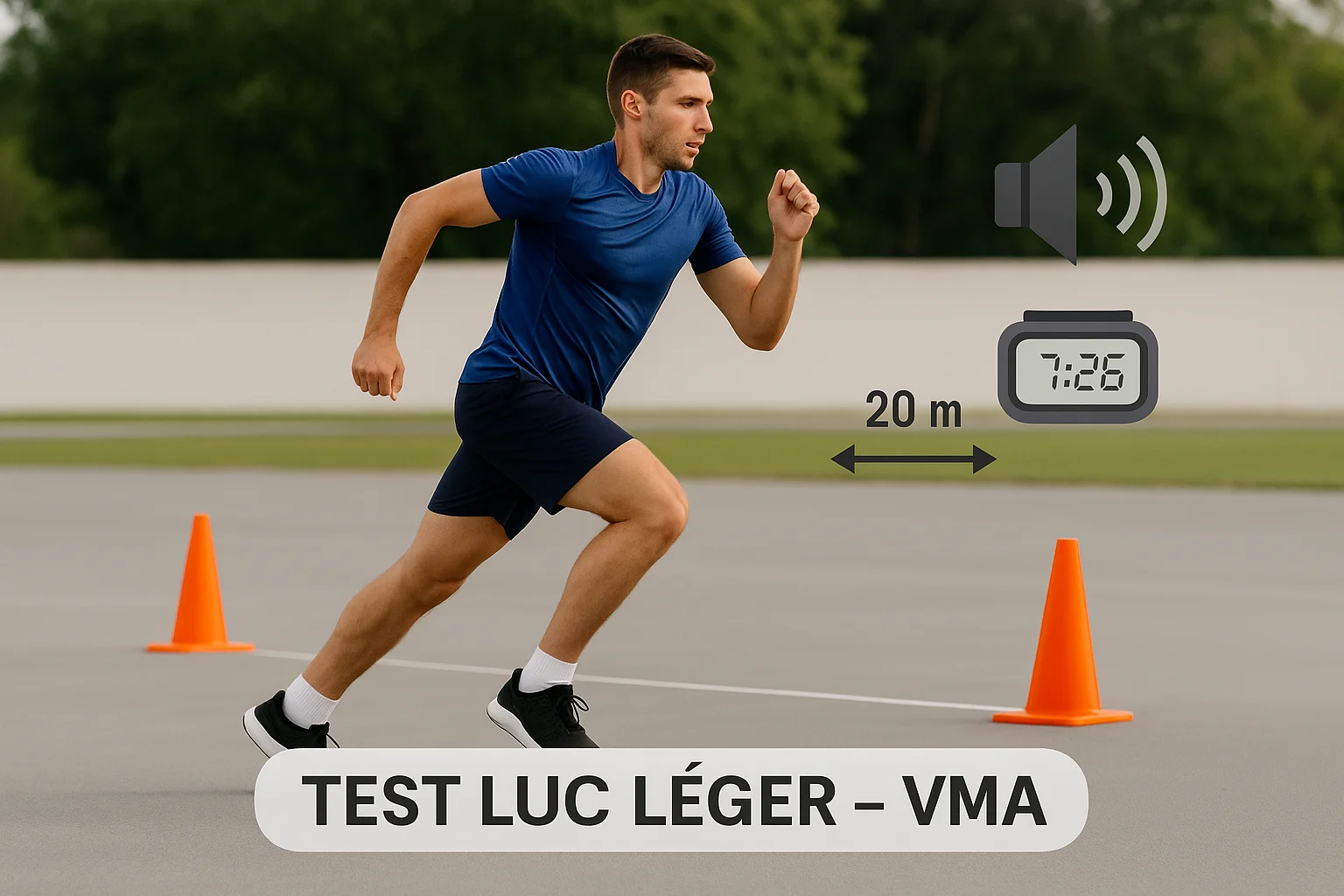
Used worldwide in professional sport (football, rugby, athletics) and the armed forces, the Luc Léger test is recognised for its reliability in assessing maximal aerobic capacity. It consists of 20-metre back-and-forth runs at a progressively increasing speed, guided by sound signals (beeps).
Luc Léger Shuttle Run Test Protocol
Prepare the space
Mark 2 lines exactly 20 metres apart on a stable surface
Complete warm-up
10-15 min with joint mobility and dynamic stretching
Follow the audio pace
Initial speed 8.5 km/h, +0.5 km/h each stage
Stopping the test
Stop when you can no longer reach the line at the beep; for an exam, follow the organiser's rules
Medical warning: The Luc Léger test is a very demanding maximal effort. Consult a doctor before taking it, especially if you have a history of heart problems. Stop immediately in case of chest pain, dizziness or faintness.
Shuttle Run Test Stages Table
This table describes the soundtrack shipped on this page: speeds, durations and shuttles were measured on the audio file itself. It does not replace the official standard of any exam.
↔ Swipe the table horizontally to see every column.
| Stage | Speed (km/h) | Stage time | Shuttles | Cumulative distance |
|---|---|---|---|---|
| 1 | 8.5 | 60s | 7 | 140m |
| 2 | 9.0 | 56s | 7 | 280m |
| 3 | 9.5 | 61s | 8 | 440m |
| 4 | 10.0 | 65s | 9 | 620m |
| 5 | 10.5 | 55s | 8 | 780m |
| 6 | 11.0 | 59s | 9 | 960m |
| 7 | 11.5 | 63s | 10 | 1160m |
| 8 | 12.0 | 60s | 10 | 1360m |
| 9 | 12.5 | 58s | 10 | 1560m |
| 10 | 13.0 | 61s | 11 | 1780m |
| 11 | 13.5 | 64s | 12 | 2020m |
| 12 | 14.0 | 57s | 11 | 2240m |
| 13 | 14.5 | 60s | 12 | 2480m |
| 14 | 15.0 | 62s | 13 | 2740m |
| 15 | 15.5 | 60s | 13 | 3000m |
| 16 | 16.0 | 59s | 13 | 3260m |
| 17 | 16.5 | 61s | 14 | 3540m |
| 18 | 17.0 | 59s | 14 | 3820m |
| 19 | 17.5 | 58s | 14 | 4100m |
| 20 | 18.0 | 60s | 15 | 4400m |
Frequently Asked Questions About the Shuttle Run Test
How often should you do the Luc Léger test?
It is recommended to take the test every 2-3 months to assess your progress. Avoid doing it too often, as it is a maximal effort that requires good recovery.
What is the difference between VMA and VO2Max?
VMA is the running speed (km/h) at which you reach your VO2Max. VO2Max is the maximal oxygen consumption (ml/kg/min) that your body can use.
Is the shuttle run test reliable?
Yes. The 1982 study of the adult protocol reports a correlation of r=0.84 with direct laboratory VO2max measurement, and the 1988 publication on the one-minute stage protocol reports r=0.90. It is one of the most reliable field tests.
Can I do the test on a treadmill?
The original test requires changes of direction. On a treadmill, opt for a continuous progressive test such as the Léger-Boucher test or the VAMEVAL test.
Method and sources
The soundtrack on this page follows the one-minute stage protocol: it starts at 8.5 km/h and increases by 0.5 km/h at every stage. Table data was measured from the supplied audio file and is not presented as a universal selection standard.
- Léger et al. (1988) — 20 m shuttle protocol and VO2max prediction equation (PubMed)
- Léger and Gadoury (1989) — validity of the one-minute stage version in adults (PubMed)
Protocol and soundtrack checked by Fit'Distance on 4 September 2026. The displayed MAS is the speed of the last fully completed stage.
Video: the Luc Léger test soundtrack in action
Listen to the announced stages (full soundtrack, 20 min) and visualise the pace to hold before starting the test.
 YouTube · 20 min
How to calculate your VMA with the Luc Léger test?
VMA (Maximal Aerobic Speed) corresponds to the speed of the last stage you complete fully. The test starts at 8.5 km/h and increases by 0.5 km/h at each stage announced by the soundtrack: completing the 14 km/h stage therefore gives a VMA of 14 km/h.